Signs of Mold in Air Ducts: A Homeowner Detection Guide
Your ducts are hidden, but they leave clues. The most reliable signs of mold in air ducts are a musty odor that appears when the system runs, visible discoloration around vents and returns, and allergy symptoms that ease when you leave the house. A filter that clogs dark and fast is another strong clue.
Your Air Filter Is the Fastest Clue Most Homeowners Skip
Pull your filter and look at it before you do anything else. A filter that fills with dark, grayish debris in two to three weeks, when it normally lasts 30 to 90 days, is picking up a heavy particulate load. Mold fragments and spore clusters contribute to that load, and mold debris tends to look darker than ordinary dust.
Spread the filter media open under good light. Black or dark gray patches spread unevenly across the fibers, especially concentrated on one side, suggest contamination upstream rather than general household dust. Press your nose near it. If the media carries the same musty smell you notice from the vents, you have a direct air-sample of what your system is circulating.
A dirty filter alone does not prove mold, but it is the cheapest diagnostic tool you own. Check it monthly through the cooling season, and when it tells a story, keep going down this list.
Musty Smells That Follow the HVAC Cycle Point Inside the System
Odor that appears when the system starts and fades when it stops is growing somewhere in the airflow path. The smell is not your imagination. As colonies grow, they release microbial volatile organic compounds (mVOCs), gases that smell musty or like dirty socks. Because those gases travel with the air, the odor pattern follows the HVAC cycle.
Pay attention to the timing. A smell that is strongest in the first minutes after startup, then fades, often traces back to a damp evaporator coil or a drain pan holding standing water. A smell that persists the whole time the system runs, especially across multiple rooms, points deeper: to growth inside ductwork, on a fiberglass duct liner, or in the air handler cabinet itself.
Note which rooms are affected. One musty room suggests a problem in the branch duct serving it. Every room smelling musty points to the main trunk or the air handler. That one observation will tell a professional exactly where to look first.
A Flashlight Check of Vents and Returns Takes Ten Minutes
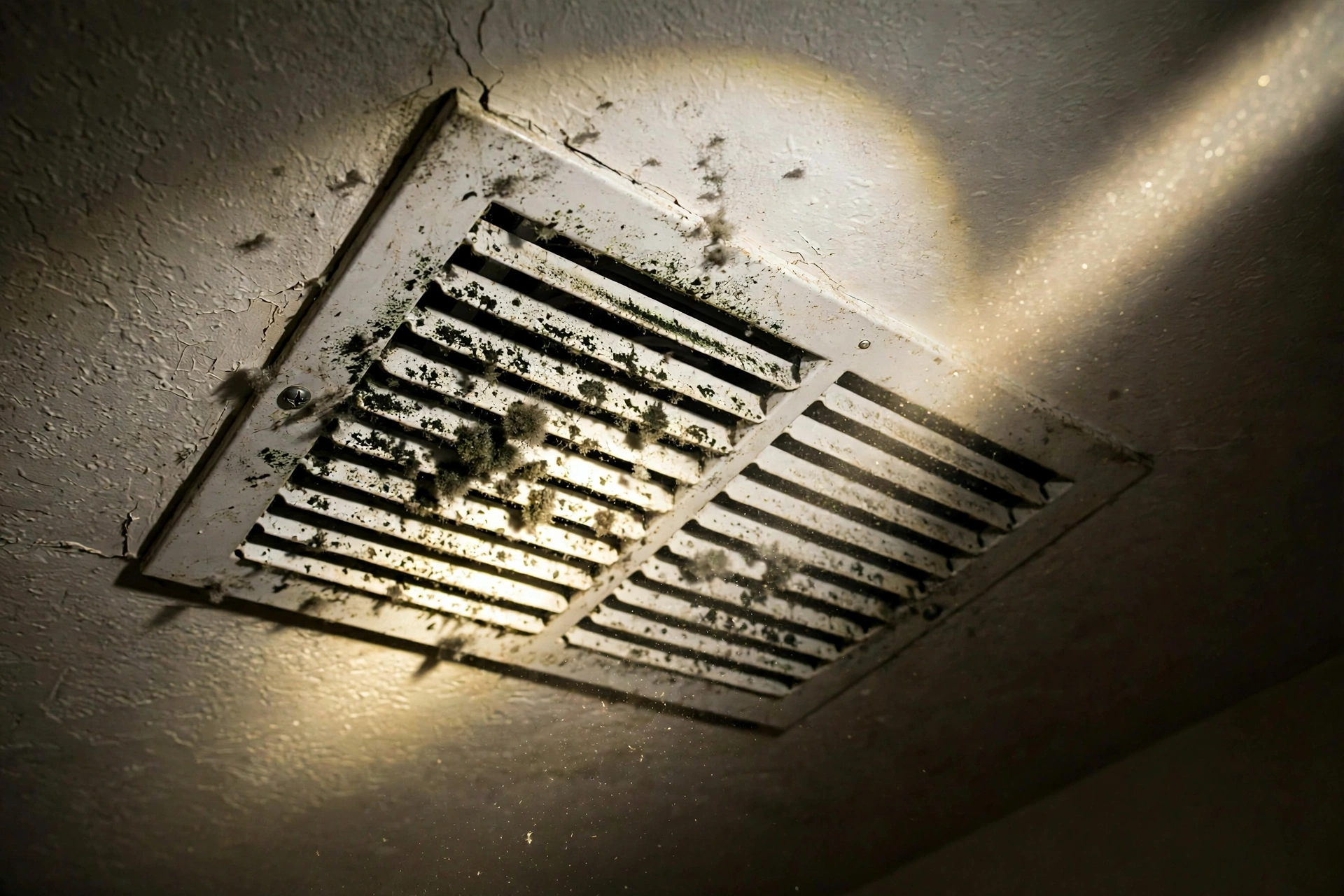
Visible growth almost always shows up at the easiest places to see: vent covers, return grilles, and the ceiling or wall around them. Remove a supply vent cover and shine a flashlight inside. Look for black, green, gray, or white speckling or fuzz on the first inches of the duct, and check the wall or ceiling paint around each register for water stains or discoloration.
A practical tell: normal dust wipes away cleanly with a damp cloth. Mold tends to smear, regrow in the same spots after cleaning, and return as irregular speckles rather than an even gray film. Recurring dark spotting on the same vent, even after wiping, is one of the most reported clues by homeowners and almost always means growth is established behind the grille.
Do not go deeper than this with your own hands. The return side, the air handler, and the coil compartment hold electrical components and, if mold is present, a concentrated spore load. Everything downstream of the vent cover is professional territory.
The Room That Smells Worst Is Usually Closest to the Problem
Ductwork branches like a tree, so the strongest clue is a localized one. If one supply register smells musty while the others do not, the growth is likely in that branch run, at its takeoff joint, or in the nearby ceiling or attic insulation. If two rooms sharing a duct run both smell, the problem is probably upstream of their split.
This matters in Florida homes because supply ducts often run through hot attics. Cold conditioned air inside a poorly insulated duct and hot attic air outside it create condensation on the exterior of the duct and sometimes inside the liner when joints leak. The branch closest to the leakiest joint or the coldest spot is where colonies establish first, and the room it feeds shows symptoms first.
Walk room to room with the system running and rank the smell at each register. That simple map is exactly what a mold assessor wants to see, and it saves you a longer inspection bill.
Past Water Damage Near the HVAC Keeps the Odds High
A leak that touched the system is still a risk factor years later if the materials were never dried or replaced. Roof leaks, burst pipes, and overflowing condensate pans soak duct insulation and fiberglass duct liner, which hold moisture long enough for mold to establish colonies. Public-health guidance treats anything that stayed wet for more than 24 to 48 hours as a mold risk.
Porous materials inside ductwork are the weak point. Fiberglass duct liner and duct insulation cannot be dried back to clean once wet, and the EPA notes that insulated or fiberglass-lined ducts that have gotten wet or moldy generally cannot be cleaned effectively and should be removed and replaced. Sheet metal ducts, by contrast, can be professionally cleaned under containment.
When you call for an inspection, tell the professional about any water event, even an old one. A two-year-old leak that was never properly dried can still harbor active growth feeding spores into your air today.
Mold Looks Different From Ordinary Dust and Soot
Mold grows fuzzy, speckled, or irregular, while dust and soot wipe away cleanly. Other look-alikes include candle soot and ghosting, the dark staining where household dust adheres to cooler wall studs behind paint. A few tells separate real growth from false alarms.
Growth pairs with moisture and smell. Dust collects evenly with no odor. If the dark smudging near your vents wipes away easily, has no musty smell, and returns slowly as an even film, it is probably ordinary household dust. If it smears, feels fuzzy, concentrates near a moisture source, and returns quickly as speckles, treat it as mold until a professional with a moisture meter confirms otherwise.
Do not trust color to identify it. The common duct species are Aspergillus, Penicillium, and Cladosporium, not the headline-grabbing Stachybotrys chartarum. That species needs chronically wet, cellulose-rich material and is uncommon inside metal ductwork. Health agencies are clear that all visible indoor mold signals a moisture problem worth correcting, regardless of color.
Three Things Not to Do Before a Professional Looks
The wrong first move spreads spores and wastes money. First, do not keep running the system to air out the smell. The EPA warns that operating an HVAC system suspected of mold contamination pushes spores throughout the building. Shut it off and wait for an inspection.
Second, do not spray bleach, vinegar, or fogging products into the ducts. Surface sprays cannot reach growth inside ductwork, they can drive spores deeper into the system, and they do nothing for the porous fiberglass liner that actually needs removal. Chemical fogging without containment and HEPA filtration often makes the distribution problem worse.
Third, do not pay for laboratory testing of growth you can already see. The EPA takes a practical stance: visible mold means it is time to act, not test. Testing is useful for insurance documentation or settling a dispute, not for deciding whether the mold you can smell and see needs attention. Spend that money on the inspection instead.
When the Answer Is a Professional Inspection
If two or more of the signs of mold in air ducts described above show up together, get a professional with containment and HEPA-grade equipment. Proper remediation follows IICRC standards: the work area is isolated under negative air pressure, contaminated air is pulled through HEPA filtration, and porous materials that cannot be cleaned are removed rather than painted over.
That is not the same job as duct cleaning. Duct cleaning removes dust; mold remediation removes a living colony and fixes the moisture that feeds it. Our HVAC mold removal service explains what a real remediation visit includes. If you are unsure whether the problem calls for a technician or a specialist, read who should actually check for mold in HVAC. And if the smell keeps returning after a cleaning, mold that comes back in your AC covers the moisture sources cleaners usually miss.
One more pattern worth knowing: mold in the ductwork is not always separate from the rest of the system. When ducts run through the attic, the same humidity that feeds duct growth feeds insulation growth, which is why mold in attic ductwork versus insulation is a common combined problem in Florida homes.
Frequently Asked Questions
Is mold in air ducts dangerous?
It can be a real problem for sensitive people. The CDC notes that mold exposure can cause nasal and sinus congestion, coughing, wheezing, throat irritation, and eye irritation, and mold is a recognized asthma trigger. Because ducts distribute air to every room, exposure happens throughout the home rather than near one damp spot. Children, older adults, and people with asthma, allergies, or weakened immune systems face the highest risk. Symptoms alone cannot confirm mold, since pollen and dust cause similar reactions, but the pattern of symptoms easing when you leave the house is a meaningful clue.
Can I clean mold from my air ducts myself?
Surface spots on a removable vent cover are fine to clean yourself with basic protective gear. Anything inside the ductwork, on the coils, or in the air handler needs a professional. Uncontained cleaning spreads spores through the home, and wet fiberglass duct liner cannot be cleaned at all and must be replaced. When in doubt, the boundary is the vent cover: outside it is yours, inside it belongs to a certified professional.
Why does the musty smell come and go?
The smell comes from microbial gases released as colonies grow, and those gases travel with the air. The odor is often strongest at startup, when the first rush of air picks up concentrated gases from a damp coil or drain pan, then fades as the system runs. A smell that never fades while the system runs usually means growth deeper in the ductwork or air handler, where air passes over it continuously.
Does mold in air ducts spread through the whole house?
Yes, that is the core difference between duct mold and mold on a single wall. The supply system pushes air from the ducts into every room it serves, so spores and odor fragments travel with each cycle. That is why the EPA advises against running an HVAC system you suspect is contaminated. The spread is mechanical, not a mystery, which is also why catching it early keeps the job smaller.
Why do my vents keep getting moldy after I clean them?
Because the moisture source was never fixed. Recurring growth on the same vents is one of the clearest signals that water is still feeding the colony: a slow condensate leak, a blocked drain line, humid attic air entering through leaky joints, or wet porous liner that was cleaned instead of replaced. Cleaning without fixing the moisture guarantees the mold returns.
Should I get a mold test for my ducts?
Usually not. If you can see growth or smell it clearly when the system runs, you already have your answer: find the moisture and remediate. The EPA takes the same practical position. Testing is worth it when you need documentation for insurance or a landlord dispute, or when symptoms are severe and a doctor or assessor wants to confirm the species. Do not pay for testing to prove mold is absent after you already found it.
How often should I check my ducts for mold?
Glance at your filter every month during the cooling season and at your vent covers a few times a year. Schedule a professional inspection after any water event that touched the HVAC system and every couple of years in humid climates. The standing prevention habits matter most: keep indoor relative humidity below 50 percent, change filters every 1 to 3 months, and keep the condensate drain line flowing.
Talk to a Mold Specialist in Hollywood FL
If the clues above sound familiar, get a professional inspection before the next cooling cycle spreads spores further. A proper inspection finds the moisture source, not just the colony. Call +1 (954) 676-1007 and tell us which room smells worst and whether the smell follows the HVAC cycle. Those two details will tell us exactly where to look first. You can also find our service area on Google Maps.
Why does my AC smell musty for the first few minutes and then go away?
That pattern usually traces to a damp evaporator coil or standing water in the drain pan. The first rush of air picks up concentrated microbial gases, then the odor dilutes as the system runs. Have the condensate drain line and coil checked, because the startup smell is an early warning that deeper growth is starting.
Can I just spray something into the vents to kill the mold?
No. Sprays cannot reach colonies inside ductwork, they can push spores deeper, and they do nothing for porous fiberglass liner that must be replaced rather than cleaned. Proper remediation uses containment, negative air pressure, and HEPA filtration to remove the growth and the moisture feeding it.
Is black stuff around my vents definitely mold?
Not always. Ordinary dust and candle soot also darken vent covers. Mold is usually fuzzy or speckled, smears instead of wiping clean, returns quickly to the same spots, and is paired with a musty smell. A professional with a moisture meter can confirm it in one visit.
Do I need to replace my whole duct system if there is mold?
Usually not. Sheet metal ducts can be professionally cleaned under containment, and spot sections of wet fiberglass liner can be replaced without tearing out the whole run. Replacement is needed when porous materials are wet and moldy, which cleaning cannot fix.





3 Comments