
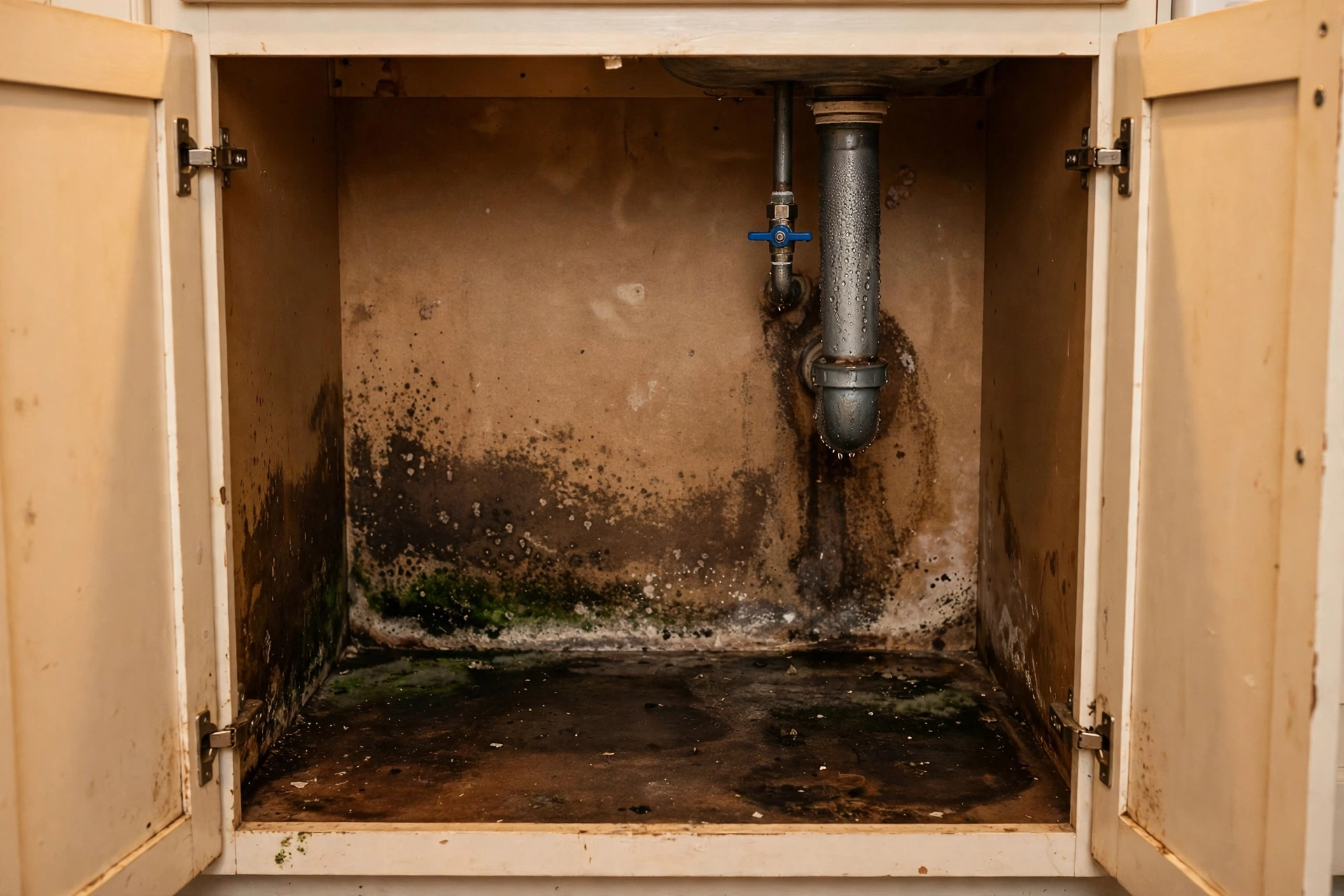
Mold Behind the Kitchen Sink: General Moisture vs a Bigger Problem
Mold behind the kitchen sink comes from one of two kinds of moisture: everyday moisture you can manage, or a hidden problem that needs a professional. Everyday sources include condensation, splashes, and damp clutter. Hidden problems include slow leaks, water wicking into the wall, and saturated particleboard. The tests below show which one you have.
Kitchen sink mold problems fall into two distinct categories
Treating the mold without knowing which category you are in is why most under-sink mold comes back. Surface mold from everyday moisture responds to drying and cleaning. Mold fed by a hidden leak, a failed seal, or water trapped inside the wall keeps growing no matter how often you scrub it. If you are researching kitchen sink mold causes, start by sorting your situation into one of these two groups before you clean anything.
Everyday moisture sits on surfaces you can reach: the cabinet floor, the backs of doors, the outside of pipes. Hidden problems live where you cannot see: inside the cabinet back panel, behind the drywall, or under the subfloor. The rest of this guide walks through each source, the signs that separate the two, and simple tests to tell them apart.
Everyday moisture sources grow mold on surfaces you can reach
Most surface mold under and behind kitchen sinks starts with ordinary kitchen life, not a plumbing failure. These sources add small amounts of moisture regularly, and the dark, enclosed cabinet gives mold spores a calm place to settle and multiply.
Condensation on cold water supply pipes
When warm, humid kitchen air meets cold metal or plastic supply pipes, water condenses on the pipe surface, just like on a cold drink on a hot day. The droplets run down and pool on the cabinet floor. In Florida kitchens, where air conditioning cycles on and off and humidity runs high, this can happen daily without any leak at all. Foam pipe insulation sleeves raise the pipe surface temperature above the dew point and stop this cycle.
Splash and seepage around the sink rim
Water splashes around the sink basin during dishwashing and food prep. If the caulk bead between the sink rim and the countertop has cracked or pulled away, that water slips underneath and drains through the countertop substrate into the cabinet below. This source is easy to miss because no pipe is leaking. Inspect the full perimeter of the sink rim from above for gaps, cracks, or separated sections.
Damp items stored under the sink
Wet sponges, damp dish towels, and cleaning rags tossed under the sink never fully dry in a dark cabinet. They hold moisture against the cabinet floor and feed mold directly. Even spray bottles and cleaning products leave wet residue that keeps surfaces damp. Moving sponges and cloths out of the cabinet and replacing them regularly removes a common and overlooked food and moisture source.
Trapped humidity in a closed cabinet
Kitchen cabinets stay closed most of the day, so humid air from cooking, the dishwasher, and hot water use gets trapped inside with no way out. When relative humidity inside the cabinet stays above 60 percent, mold spores can germinate on wood, particleboard, and cardboard even without a drip. The EPA recommends keeping indoor relative humidity between 30 and 50 percent. Opening the cabinet doors after cooking or running the dishwasher gives the space the air exchange it needs.
Bigger problems show signs that surface moisture cannot explain
A hidden leak or wall-cavity problem leaves clues that go beyond a few spots on the cabinet floor. Watch for these signs, because each one points past the surface and into the structure:
- Mold returns within weeks of a thorough cleaning, which means an active moisture supply is still feeding it.
- The musty smell is strongest inside the cabinet or near the wall, and persists even after you clean every visible surface.
- The cabinet floor or back panel feels soft, spongy, or swollen, which means the particleboard has absorbed water and is breaking down.
- Water stains, discoloration, or peeling laminate spread across the back panel or onto the adjacent cabinet walls.
- You find dampness or staining on the kitchen floor near the sink base, which suggests water has traveled under the flooring.
- The caulk around the sink looks fine and the pipes look dry, yet the cabinet floor is damp again the next day.
- You notice staining or softness on the wall above or beside the sink, which means moisture has moved into the drywall cavity.
Water travels behind cabinets in ways most homeowners never see
Most kitchen sink cabinets have a back panel made of thin hardboard or particleboard, and many have a false floor above the actual cabinet base. When water reaches these materials, it wicks sideways and upward through the fibers, spreading far beyond the original drip. The drywall behind the sink absorbs the same way, and water can continue into the wall cavity and down to the subfloor.
Two hidden pathways deserve special attention. First, the gaps around pipe penetrations through the cabinet floor and back wall admit humid air from inside the wall cavity or subfloor space, adding steady moisture even when nothing drips. Second, many cabinets have a raised false bottom with an unseen void beneath it, a favorite place for slow leaks to pool undetected. The EPA notes that mold can begin growing on wet materials within 24 to 48 hours, so a small hidden leak becomes a structural problem quickly.
This is also where mold species change the stakes. Surface mold on dry cabinet wood is often Cladosporium, Penicillium, or Aspergillus, common allergenic molds. Chronically wet cellulose materials like soaked particleboard and paper-faced drywall can host Stachybotrys chartarum, the species known for producing trichothecene mycotoxins, and Chaetomium, which often announces itself with a strong musty odor before it becomes visible. You cannot identify species by color alone, but long-term saturation of cellulose is exactly the condition where the more concerning species appear.
A simple set of tests tells you which problem you have
You do not need professional equipment to sort a surface-moisture situation from a hidden problem. Knowing which kitchen sink mold causes are active in your cabinet changes what you do next, so run these checks in order, because each one answers a different question.
The touch-and-dry test
Dry the cabinet completely with a fan, then leave the pipes alone and the cabinet closed for 24 hours without using the sink. If every surface is still dry, the moisture likely came from usage patterns like splashes or damp items. If the cabinet floor or back panel is damp again, an active source is feeding water into the space.
The paper towel test for slow drips
Wrap dry paper towels around each P-trap slip-joint nut, supply line fitting, and shut-off valve, then check them the next morning. A slow drip too small to see as falling drops will leave a telltale wet ring on the towel. These hairline leaks at slip-joint washers and compression fittings are among the most common overlooked sources.
The smell and regrowth timeline
Surface mold cleaned from a dry source stays gone. Mold that returns within two to eight weeks of cleaning is receiving an active moisture supply, even if you cannot see it. A musty odor with no visible mold almost always means growth is hidden: inside the back panel, in the wall cavity, or under the false floor.
The moisture meter check
An inexpensive pin-type moisture meter pressed into the cabinet floor and back panel tells you what your eyes cannot. Readings that stay elevated days after the area looks dry mean water is trapped inside the material. Professionals map moisture across the whole area before deciding what to remove, and a meter is the homeowner version of that first step.
Professionals check places homeowners cannot reach
When the tests above point to a hidden problem, a professional assessment covers the areas your checks cannot. Technicians inspect behind the cabinet back panel and inside the wall cavity, trace staining patterns to find the original entry point, and use moisture meters to map how far water traveled through particleboard, drywall, and subfloor. The everyday kitchen sink mold causes respond to the fixes in the next section, while hidden saturation calls for a different approach.
Professional remediation follows the IICRC S520 standard: the work area is sealed off with containment, negative air pressure keeps spores from spreading through the house, and debris is captured with HEPA filtration. Porous materials that cannot be fully cleaned, such as swollen particleboard or saturated drywall, are removed rather than scrubbed, because mold mycelium grows into the fibers where surface cleaning cannot reach. The EPA guideline used across the industry treats mold areas larger than about 10 square feet, or any growth inside wall cavities, as work for a trained contractor rather than a DIY project. The CDC advises that people with asthma, allergies, or weakened immune systems avoid exposure during cleanup regardless of area size.
If you decide to involve a professional, document what you found: dated photos of the mold, your moisture meter readings, and notes on when the mold returns. For renters, this documentation also matters when reporting the problem to a landlord, since responsibility often turns on whether the cause was a hidden leak or tenant-caused moisture.
Everyday prevention keeps surface mold from starting
Once the moisture source is fixed, a few habits keep the cabinet dry enough that mold spores cannot establish themselves.
- Insulate cold water supply pipes with closed-cell foam sleeves to stop condensation at the source.
- Inspect the sink rim caulk once a year, and remove and replace any cracked or separated sections with waterproof silicone caulk.
- Place a waterproof tray or mat under the sink base to catch drips before they reach the particleboard.
- Store sponges and dish cloths outside the cabinet, and replace sponges before they stay permanently damp.
- Open the cabinet doors after running the dishwasher or cooking a steamy meal to let humid air escape.
- Keep indoor relative humidity between 30 and 50 percent, per EPA guidance, using your air conditioner or a dehumidifier in humid months.
- Seal the gaps around pipe penetrations through the cabinet floor and back wall with silicone to block humid air from the wall cavity.
These steps handle the everyday side of the problem. If mold keeps returning despite all of them, you are likely dealing with one of the hidden problems described above, and the right move is an inspection rather than another round of scrubbing. Our guide to bathroom ceiling drywall mold covers a similar moisture-first approach for another common spot, and our black mold behind the kitchen sink article explains when the species itself raises the stakes.
Frequently asked questions
Why does mold keep coming back behind my kitchen sink after I clean it?
Recurring mold means an active moisture source was never fixed. The most common overlooked sources are a slow drip at the P-trap slip-joint nuts, condensation on cold supply pipes, a failed sink rim caulk bead, and humid air entering through gaps around pipe penetrations. Clean only after every source is repaired.
How can I tell if the mold is just on the surface or inside the wall?
Press the cabinet back panel and floor firmly. If the material feels solid and the mold wipes off intact wood, it is likely surface growth. If the panel feels soft, swollen, or crumbly, moisture has penetrated the material and the wall cavity behind it may be affected too. A musty smell with no visible mold is another strong sign of hidden growth.
Is a musty smell under the sink always mold?
Not always, but it is the most common cause. A sour or musty odor can also come from organic buildup in the P-trap or garbage disposal. Clean the disposal and flush the drain first. If the smell persists after the drain is clean, suspect hidden mold in the back panel, under a false cabinet floor, or inside the wall cavity.
What is the false floor under my sink cabinet?
Many sink cabinets have a raised floor panel with a hollow void beneath it, sitting above the actual cabinet base. Slow leaks can pool in that void for months without any visible sign. If you suspect hidden water, this is one of the first places to check, and a small inspection opening can reveal what is happening underneath.
Can I just bleach the mold and be done with it?
Bleach can kill surface mold on hard, non-porous surfaces, but it does not reach mold mycelium growing inside porous particleboard or drywall. Worse, cleaning without fixing the moisture source guarantees the mold returns. Fix the water first, remove porous materials that are soft or swollen, then clean the remaining hard surfaces and dry everything completely.
My cabinet particleboard is swollen. Does it need to be replaced?
Yes. Swollen particleboard has lost its structural integrity and holds moisture deep inside its fibers, where no surface treatment can reach. Cut out and replace the damaged section with dry material, and fix the water source before installing the replacement, or the new panel will suffer the same fate.
I rent my home. Who is responsible for mold behind the kitchen sink?
It depends on the cause and your state, but hidden plumbing leaks and structural moisture problems are generally the landlord’s responsibility to repair. Document everything: dated photos, moisture meter readings, and a written record of when you reported it. Report the problem in writing and keep copies, because responsibility often turns on whether the cause was a hidden defect or tenant-caused moisture.
Hey, I cleaned the mold under my kitchen sink twice and it keeps coming back. What am I missing?
You are missing the moisture source. Mold that returns within weeks is being fed by water you have not found yet: a slow P-trap drip, pipe condensation, a failed sink caulk bead, or humid air leaking through pipe gaps. Run the paper towel test on every fitting, insulate the cold pipes, and check the caulk before you clean again.
Should I be worried about black mold behind my kitchen sink?
Color alone does not identify the species, so worry less about the color and more about the moisture history. Mold on a surface that got wet once and dried is usually a common allergenic type. Mold growing on particleboard or drywall that has stayed wet for weeks can include Stachybotrys chartarum, which is why chronic saturation deserves a professional look.
Can I handle mold behind the kitchen sink myself or do I need a pro?
You can handle it yourself when the growth is small (the EPA uses about 10 square feet as the practical line), sits on surfaces you can reach, the material is still solid, and you can find and fix the moisture source. Call a professional when the mold is inside the wall cavity, the particleboard is soft or swollen, the area is large, or anyone in the home has asthma or a weakened immune system.
What is the one thing that stops kitchen sink mold from coming back for good?
Eliminating the moisture source completely. Every lasting fix, whether it is tightening a slip-joint nut, insulating a cold pipe, re-caulking the sink rim, or sealing a pipe penetration, works because it removes the water the mold needs. Cleaning is the last step, not the first.
Get a Clear Answer on Your Kitchen Sink Mold in Hollywood FL
If your tests point to a hidden problem, or the mold keeps returning no matter what you try, a professional inspection finds the moisture source behind the cabinet and inside the wall before the damage spreads further. Mold removal for bathrooms and kitchens in Hollywood starts with moisture mapping and an honest assessment of what can be saved. Call +1 (954) 676-1007 to schedule service, or find us on Google Maps.





One Comment