How to Remove Mold from Bathroom Ceiling Drywall
If you need to know how to remove mold from bathroom ceiling drywall, start with the drywall itself. Surface mildew from shower steam on firm, painted drywall is usually cleanable in an afternoon. Growth fed by a leak, or drywall that has gone soft, sagging, or stained through, is a removal job. Here is how to tell the difference.
First Decide Whether Your Ceiling Drywall Can Be Cleaned at All
Drywall is gypsum sandwiched between two layers of paper, and that paper is exactly what mold eats. Once mycelium, the root-like network of a mold colony, grows into the paper facing and the gypsum core beneath the paint, no surface cleaner reaches it. Cleaning that ceiling makes it look clean for a few weeks, then the spots return in the same footprint.
Run three checks before you touch a spray bottle.
- Press the spot gently with a fingertip. Firm drywall that only shows surface discoloration is usually cleanable. Drywall that gives, crumbles, or feels spongy has lost its structure and must be cut out and replaced.
- Look for a brown or yellow tide line ringing the spot. A stain ring means water moved through the material, and the growth is almost certainly deeper than the paint.
- Check the size. The EPA cleanup guidance draws a practical line at about 10 square feet, roughly a three by three foot patch. Below that, a careful homeowner can usually handle it. Above it, hire a professional with containment and HEPA filtration.
If the drywall passes all three checks, keep reading. If it fails even one, skip the cleaning and read the section on calling a professional. For a deeper look at that clean versus replace decision, our guide on whether moldy drywall can be saved or has to be replaced walks through the porosity rules room by room.
Condensation and a Leak Look Different, and the Fix Depends on It
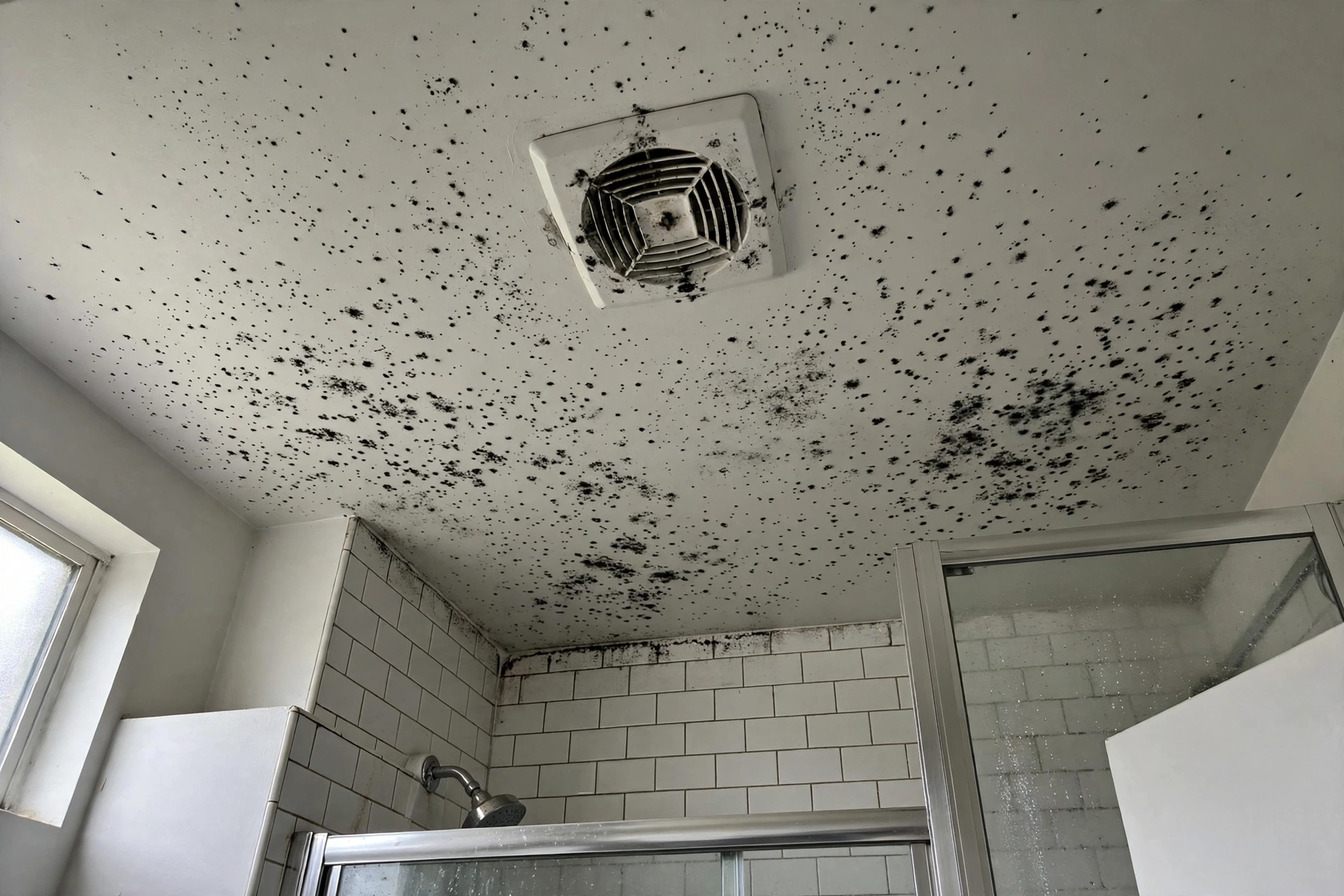
Ceiling mold comes from one of two things, and they are not the same job. Condensation from shower steam leaves fine, even speckling spread across a broad area, usually directly above the shower or along an outside wall. The drywall feels firm and the paint is not stained from underneath.
A leak leaves a defined patch with an edge, often ringed by a brown or yellow tide line. It may sit nowhere near the shower, it tends to return in the same footprint after rain or plumbing use, and the drywall around it may sag or feel soft.
Location is the tell most people miss. Mold above the shower is nearly always steam. Mold in a bathroom corner against an exterior wall is usually a cold-surface condensation problem. Mold in the middle of a ceiling, far from the shower, points to water entering from above. Condensation is a ventilation fix you can often handle. A leak means the roof, the pipe, or the bathroom upstairs has to be repaired before anything you do to the ceiling will hold.
Color alone does not identify the species. Above a shower, the fine black or gray speckling is most often common Aspergillus or Penicillium species feeding on paint and dust, not Stachybotrys chartarum. That species needs chronically wet, cellulose-rich material and shows up with sustained leaks. Public health agencies are consistent on the point that matters: all visible indoor mold signals a moisture problem worth correcting, whatever the color.
Vinegar Beats Bleach on Painted Drywall for One Simple Reason
Here is the practical case for how to remove mold from bathroom ceiling drywall without ruining it. Drywall paper is porous. Bleach is mostly water with sodium hypochlorite, and the hypochlorite evaporates off porous surfaces quickly while the water soaks in, feeding exactly what you are trying to kill. It lightens the stain so the mold looks gone, while the roots stay alive in the paper.
Undiluted white distilled vinegar penetrates the painted surface better and does not flood the drywall with extra water. The working method is simple: spray the spot generously, let it sit for about an hour so it can reach the root structures, then wipe with a soft cloth using light pressure. Aggressive scrubbing tears the paint film and drives spores deeper into the paper facing.
For heavier surface staining, 3 percent hydrogen peroxide is the backup. Spray it on, let it fizz for 10 to 15 minutes, then wipe gently. Test a small hidden area first, because peroxide can lighten some ceiling paints. Dry the ceiling thoroughly afterward with the fan running and the door open. A ceiling that is still damp when you walk away starts the cycle over.
Work Overhead Without Spreading Spores Through the Room
Scrubbing a ceiling rains spores, dirty water, and drips straight down onto you and everything below. Gear up before you start: sealing safety goggles, an N95 respirator, and gloves. An ordinary dust mask does not filter fine spore particles.
Sheet the tub and floor with plastic or old towels so drips land somewhere you can wash. Close the door to keep spores out of the rest of the house, but open the window if the bathroom has one and run the exhaust fan throughout. This matters in a small enclosed bathroom where bleach or peroxide fumes concentrate fast, another reason to favor vinegar.
Wet the spot before you scrub it. Spraying the growth first weighs the spores down so they cannot float into the air in a dry cloud. Work in small sections, keep your wiping motions controlled, and bag the cloths when you are done rather than shaking them out in the room. Professionals isolate the whole work area under containment and negative air pressure and filter the air through HEPA filtration. At home, the wet method plus sealed eye protection is the scaled down version of the same principle.
The Fix That Actually Stops It From Coming Back Is the Exhaust Fan
Cleaning removes the colony. Only drying the room between showers keeps it from returning. Nearly every repeat ceiling mold call traces back to ventilation that was never addressed. Three checks take ten minutes and settle it.
First, the tissue test. With the fan running, hold a single sheet of tissue flat against the grille. If it does not press firmly against the grille and stay there, the fan is not moving enough air. Bathrooms need roughly one CFM, cubic foot per minute, of fan capacity per square foot of floor area, with a minimum of 50 CFM. Most builder grade fans in older homes fall well below that.
Second, the mirror test. If the mirror is still fogged ten minutes after the shower ends, the fan is losing the moisture battle. Run the fan during the shower and at least 20 minutes after. A timer switch handles that better than memory, and it is one of the cheapest fixes in home maintenance.
Third, the duct test. Find where the fan actually vents. A fan that dumps into the attic instead of outdoors moves the moisture problem upstairs instead of solving it, and in a humid climate that trade creates attic mold on the other side of your ceiling. The duct should terminate through the roof or a side wall.
Keep indoor relative humidity between 30 and 50 percent. A small digital hygrometer in the bathroom costs a few dollars and ends the guessing. If the bathroom has no exhaust fan at all, adding one is the single highest value upgrade for a mold prone bathroom in Hollywood FL, where the warm humid air outside keeps drying times long year round.
Painting Over Live Mold Buys You a Few Months, Not a Fix
Mold resistant primer sprayed over live mold is one of the most repeated mistakes in bathroom work. It covers the stain for a few months while the colony keeps eating the paper backing behind the paint, then the spots print through again, now under a layer that has to be scraped off too.
Primer belongs on a ceiling that is already cleaned, fully dry, and fixed at the moisture source. The right order is: fix the ventilation or the leak, clean and dry the ceiling, wait at least a full day to confirm it stays dry, then seal any residual staining with a stain blocking primer and finish with a mold resistant ceiling paint in a satin or eggshell sheen. Flat ceiling paints absorb moisture and hold mildew; they are one of the quiet reasons bathroom ceilings mold in the first place.
If you repaint, never paint a damp ceiling. Trapped moisture blisters the new paint within months and restarts the growth cycle under a fresh coat.
When the Answer Is a Professional Instead of Another Bottle of Spray
Call a professional when any of these are true: the affected area is larger than about 10 square feet, the drywall is soft or sagging, there is a brown stain ring, the mold returns in the same footprint after you cleaned it properly, the source is a roof or plumbing leak, there is a musty smell you cannot trace, or the ceiling is textured popcorn that may predate asbestos regulations. Scraping or sanding that texture without testing can turn a mold job into an asbestos exposure.
A proper remediation visit starts with moisture meters, not a spray bottle. Readings in the drywall around the stain tell a professional whether water is still entering, which decides whether the ceiling gets cleaned or opened. If the cavity has to be opened, containment goes up first so spores do not spread through the house, and porous insulation or drywall that cannot be cleaned is removed under IICRC standards rather than painted over.
That visit is also where independent verification matters. Mold assessors and remediators should be separate parties in Florida, so the person diagnosing the moisture is not the same person selling you the demolition. If the mold sits on the inside face of the ceiling, mold below the bathroom on another floor, or the signs point deeper, our guide to signs of mold growing behind the drywall covers what happens when the problem is inside the wall cavity. And when the whole room keeps showing growth, our bathroom and kitchen mold removal service explains what a professional visit includes.
Frequently Asked Questions
Is it safe to clean mold off my bathroom ceiling myself?
Yes, if the patch is smaller than about 10 square feet, the drywall is firm and dry, and the growth comes from shower condensation rather than a leak. Wear sealing goggles, an N95 respirator, and gloves, wet the spot before scrubbing so spores do not go airborne, and ventilate the room throughout. Stop and call a professional if the drywall feels soft, the patch is large, or the source is a leak.
Why does mold keep coming back on my bathroom ceiling after I clean it?
Because the moisture keeps coming back. Cleaning removes the visible colony but changes nothing about the conditions that grew it. The usual culprits are an undersized or unused exhaust fan, a fan that vents into the attic instead of outdoors, or the habit of switching the fan off the moment you leave the bathroom. Until the ceiling dries between showers, the growth returns on the same schedule.
Can I use bleach on moldy bathroom ceiling drywall?
It is a poor choice for drywall. Bleach lightens the stain but its active ingredient evaporates off porous surfaces quickly, leaving mostly water, which soaks into the paper facing and feeds the colony. Undiluted white vinegar penetrates painted drywall better and does not add extra water. Save bleach for non porous surfaces like tile and sealed grout.
Can I just paint over the mold on my bathroom ceiling?
No. Mold resistant primer over live mold buys a few months while the colony keeps feeding on the paper backing, then the spots print through under a layer you now have to scrape off. Fix the moisture source first, clean and fully dry the ceiling, then prime and repaint with a mold resistant ceiling paint.
How long should I run the bathroom exhaust fan after a shower?
During the shower and at least 20 minutes after. Use the mirror test: if the mirror is still fogged ten minutes after the shower ends, extend the runtime or upgrade the fan. A timer switch makes this automatic, and the fan must vent outdoors, not into the attic.
Is black mold on a bathroom ceiling dangerous?
Color does not identify a species, so the black color alone does not tell you the risk. The CDC notes that mold exposure can cause nasal and sinus congestion, coughing, throat irritation, and eye irritation, and mold is a recognized asthma trigger. Children, older adults, and people with allergies or asthma face the highest risk. Treat all visible indoor mold as a moisture problem to fix, regardless of color.
Can moldy ceiling drywall be saved, or does it have to be replaced?
Surface growth on firm, dry, painted drywall can usually be cleaned. Once the paper facing is compromised, the drywall sags or feels soft, or a brown stain ring shows water moved through the material, cleaning is no longer enough and that section must be cut out and replaced. Our guide on whether moldy drywall can be saved or has to be replaced breaks down the porosity rules in detail.
Talk to a Mold Specialist in Hollywood FL
If your ceiling drywall is soft, the mold keeps returning in the same footprint, or you suspect a leak from above, cleaning it again will not fix it. Call +1 (954) 676-1007 and tell us whether the drywall feels firm or gives under your finger and whether the spot sits above the shower or away from it. Those two details tell us exactly what you are dealing with. You can also find our service area on Google Maps.
How do I know if the mold on my bathroom ceiling is from steam or a leak?
Look at the pattern. Steam leaves fine, even speckling spread across a broad area above the shower, with firm drywall underneath. A leak leaves a defined patch with an edge, often ringed by a brown or yellow tide line, possibly far from the shower, with drywall that may sag or feel soft. Steam is a ventilation fix. A leak means a roof, pipe, or upstairs bathroom needs repair first.
Can I clean the mold off my bathroom ceiling without ruining the paint?
Usually yes, if the paint is intact and the drywall is firm. Spray undiluted white vinegar on the spot, let it sit for about an hour, then wipe gently with a soft cloth using light pressure. Avoid stiff brushes and aggressive scrubbing, which tear the paint film and push spores into the drywall paper. Dry the ceiling fully with the fan running afterward.
Why does the mold keep coming back even though I run the fan?
Running the fan is not the same as the fan working. Do the tissue test at the grille: weak suction means the fan is undersized, dust choked, or disconnected. Check that it vents outdoors, not into the attic, and that it runs at least 20 minutes after the shower. A fan tied to the light switch that shuts off when you leave the bathroom is the most common reason returns happen.
Should I call a plumber or a mold company for mold on my bathroom ceiling?
It depends on the source. If the spot is above the shower, firm, and clearly steam driven, neither is needed yet: fix the ventilation and clean it. If there is a defined patch with a tide line, soft drywall, or staining far from the shower, the leak gets fixed first, then the mold gets remediated. A mold professional with a moisture meter can tell you which one you are looking at in a single visit.




2 Comments