How to Remove Mold From Attic Plywood and Roof Decking
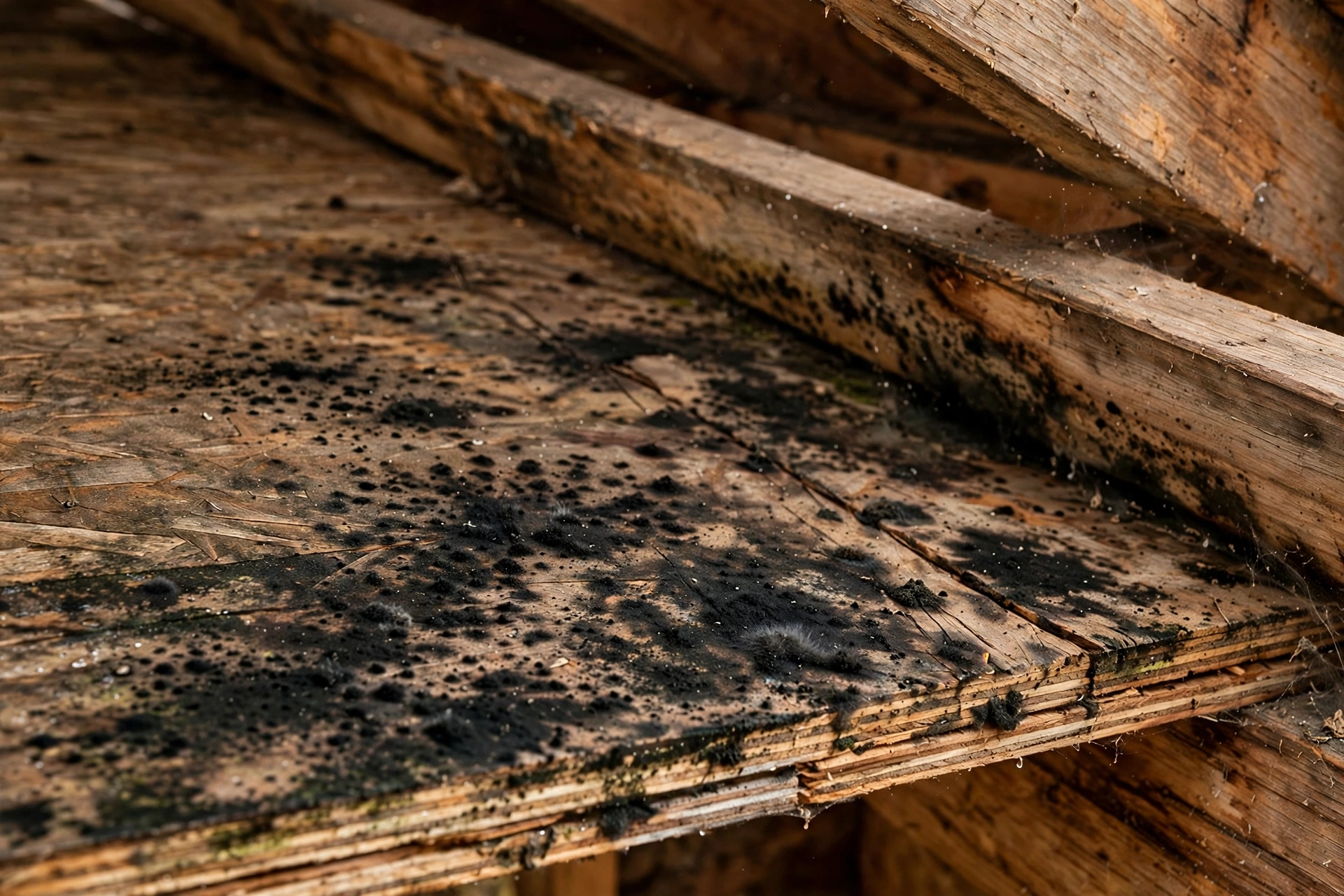
How to remove mold from attic plywood depends on the wood itself. Surface growth on firm, dry plywood can be HEPA vacuumed, scrubbed with detergent, and dried. Soft, delaminated, or rotted panels cannot be saved by cleaning and must be replaced, and the moisture source has to be fixed either way.
Florida Roof Decks Feed Mold in Every Season, Not Just After Storms
Plywood looks solid, but a deck panel is a stack of thin wood veneers bonded by glue lines, and both work in mold’s favor. The surface veneer is so thin that mycelium, the root-like network of a colony, crosses it quickly and reaches the glue line, where food and shelter wait.
The moisture supply is just as reliable. Warm, humid air from the living space rises into the attic day and night. After sunset the deck cools faster than the attic air, and that temperature gap condenses moisture on the underside of the panels, the exact surface nobody inspects. Night after night the wood cycles between damp and nearly dry, spending enough hours wet to keep colonies fed. The EPA notes mold can begin growing on wet materials within 24 to 48 hours, a line a Florida deck crosses weekly.
Storm season adds the second pathway: wind driven rain finds lifted shingles, cracked flashing, and exposed nail heads, and a slow drip can wet one bay of decking for months before a stain shows below. Between nightly condensation and small leaks, South Florida attic plywood stays wet so often that mold is the expectation, not the surprise.
Plywood, Sheathing, Rafters, and Decking Differ in Thickness, and Thickness Decides the Margin for Error
- Roof decking and roof sheathing are the same component: the flat panels nailed across the rafters, directly under the shingles. On most Florida homes they are plywood or OSB about half an inch thick.
- Plywood is veneers and glue. Mold eats the surface veneer first, then follows the glue lines sideways, which is why a small dark patch often maps to a larger colony than the stain suggests.
- Rafters and trusses are solid dimensional lumber: far thicker than decking, faster to dry, and far more forgiving of surface cleaning.
- OSB, the other common decking, swells at the edges when wet and delaminates sooner, so soft OSB goes to replacement faster.
Treating all attic wood as one material is the first mistake. The panel overhead has the least thickness, the least margin, and deserves the closest look.
One Probe Test Separates Cleanable Wood From Wood That Has to Go
Color tells you almost nothing. Soundness tells you everything, and checking it takes two minutes. That check, not the stain, decides how to remove mold from attic plywood in your attic: clean the panel in place, or cut it out.
- Press a flat screwdriver or awl into the stained wood with firm hand pressure. On sound plywood the tip dents the surface and stops. On rotted plywood it sinks, sometimes through the veneer.
- Run a pin moisture meter across the stain, then onto clean wood nearby. Readings in the high teens or above mean the panel stays wet enough to feed growth, and the moisture source is still active.
- Look along the panel edges for delamination, layers separating like the pages of a wet book. Separated veneers cannot be cleaned back into sound wood.
- Check for sag between rafters: a panel that lost its flat plane lost structural stiffness, not just color.
Firm wood with surface growth is a cleaning job. Any panel failing the probe, the meter, or the edge check is a replacement job, and scrubbing does not change that verdict.
Surface Wiping Fails on Plywood Because the Colony Lives Inside the Grain
What you see on plywood is the fruiting surface of the colony. The working part, the mycelium, threads through the grain and glue lines below the surface. A wipe removes what shows and leaves the network that regrows it, which is why wiped panels look clean for a few weeks, then spot again in the same outline.
Bleach makes the problem worse on this material. Bleach is mostly water, and on porous wood the water soaks in while the active ingredient flashes off the surface. The stain lightens, the colony stays fed, and the panel ends up wetter. Paint fails from the other direction: a coating over live growth seals moisture in, the colony keeps eating underneath, and the finish peels within a season. Real cleaning removes the growth, then dries the panel fully. Anything less is decoration.
Cleaning Sound Plywood Is a Containment Job Before It Is a Scrubbing Job
Work in the wrong order and you spread spores across the whole attic. Work in this order and the job stays local.
- Seal the attic hatch behind you and wear an N95 respirator, goggles, and gloves. Disturbing a colony launches spores, and an attic concentrates them.
- HEPA vacuum the growth first, before anything wet touches it. True HEPA filtration captures loose spores instead of pushing them airborne like dry brushing does.
- Wet the area lightly as you work. Damp spores stay where they land; dry spores travel.
- Scrub with detergent and water, working with the grain and using moderate pressure. Grinding hard tears the thin veneer and drives moisture deeper. Plain vinegar is a reasonable second pass on stubborn staining.
- Dry the panel fast, then verify it. Fans and a dehumidifier should bring the moisture meter reading back in line with dry wood nearby before you close the hatch.
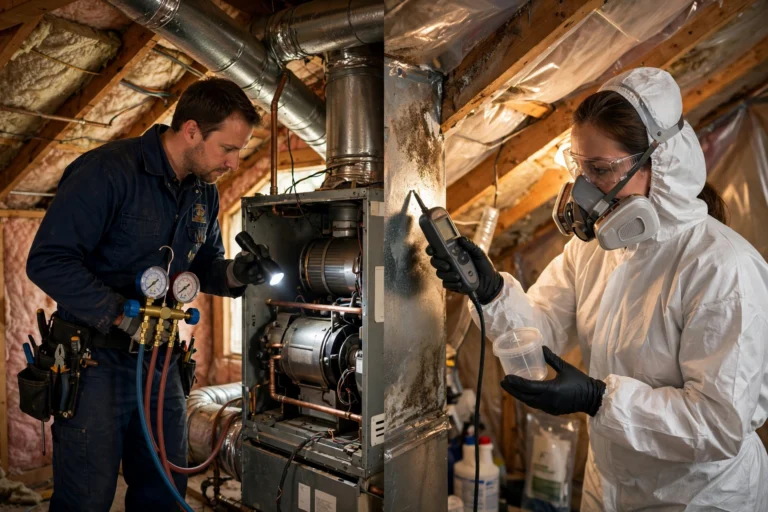
Professionals run the same sequence at a different scale: the work area goes under containment and negative air pressure, the air is scrubbed through HEPA filtration, and the moisture source is corrected as part of the job under IICRC standards. The species question matters less than homeowners expect. Dark attic growth is most often an Aspergillus or Penicillium species feeding on damp wood and settled dust. Stachybotrys chartarum, the species behind most black mold headlines, needs chronically wet cellulose and shows up where decking has leaked for a long time. Some molds produce mycotoxins, but CDC guidance is consistent: you do not need to identify the species to act. Remove the growth, fix the moisture, and the risk drops with it.
Replacement Has Clear Triggers, and Decking Work Is Roof Work
Cut out and replace any panel where the probe sinks, the layers separate, the surface sags between rafters, or growth has worked through toward the shingle side. There is no cleaning protocol for wood that has lost its structure; a soft panel left in place leaves the colony food and shelter.
Decking replacement is done from the roof side, panel by panel between rafters, and pairs best with other planned roof work.
It is also where this stops being a cleaning decision. If your probe test fails on more than a panel or two, call +1 (954) 676-1007 before cutting, and have the framing checked at the same visit, because decking that soft rarely fails alone.
Ventilation Correction Is What Keeps Cleaned Wood Clean
Every attic mold job has two halves, and the second half is airflow. Soffit vents feed air in at the eaves; ridge or roof vents let hot air out at the peak. When insulation blankets the soffits, the intake chokes and the deck underside spends far more of each night in the condensation zone. Baffles at the eaves keep that intake path open.
- A bathroom or kitchen fan that vents into the attic instead of outdoors pumps a shower’s worth of steam onto the decking daily. Rerouting it outside is one of the highest value fixes in a moldy attic.
- Watch relative humidity as your scorecard. Attic air that stays heavy and still marks a ventilation problem to solve, not a cleaning problem to repeat.
- After any storm, inspect the deck underside above new ceiling stains first. A leak caught in the first weeks is a repair; one caught after a season is a remediation.
Our guide to attic mold removal in Hollywood FL walks through how a full attic assessment ties the wood, the airflow, and the moisture source together.
Wide Growth, Soft Wood, and Repeat Growth Belong to a Professional
The EPA draws a practical line at about 10 square feet for homeowner cleanup, and plywood argues for calling sooner. Call a professional when growth spans several panels, any panel fails the probe test, mold returns after a proper cleaning, or anyone in the home has asthma or allergies. The CDC lists nasal congestion, coughing, and eye and throat irritation among common mold responses, and attic work done without containment pushes spores toward the living space below.
A professional visit starts with moisture meters across the deck and framing, not a spray bottle, and ends with the ventilation or the leak corrected, not just the stain gone. If the growth has reached the ducts or insulation below, our comparison of mold in attic ductwork versus mold in insulation explains why those materials get opposite treatments. Weighing the attempt yourself? Read what removing attic mold yourself actually involves first, or skip the ladder and call +1 (954) 676-1007 with a description of what the wood looks and feels like.
Frequently Asked Questions
Why does mold keep coming back on my attic plywood after I clean it?
Because the moisture never left. Nightly condensation or a slow leak keeps the panel wet, and surviving mycelium inside the grain regrows the colony within months. Fix the water first, then clean. Cleaned wood under an active moisture source never stays clean.
Can you paint over mold on attic plywood?
No. Paint seals moisture into the wood and the colony keeps growing underneath until the finish peels or the stain prints through. Encapsulation belongs on remediated, dried wood, never on live growth.
Does mold on attic sheathing mean my roof is leaking?
Not always. Condensation from choked ventilation causes most Florida attic mold, especially growth spread evenly across a slope. A leak paints a defined patch in one bay. Rule a leak out first either way, because cleaning mold under an active drip is wasted work.
How do you remove black mold from wood in an attic?
Color does not change the method. On firm, dry wood: HEPA vacuum the growth, scrub with detergent and water, and dry the panel fully. Soft wood, a wide area, or growth that keeps returning belongs to a professional with containment.
Can moldy roof decking be saved, or does it always need replacement?
The probe test decides. Plywood that stays firm under a screwdriver, reads dry on a moisture meter, and shows no edge delamination can be cleaned. Soft, layered, or sagging plywood must be replaced.
Will mold in my attic spread to the rest of the house?
It can. Spores move through hatch gaps, recessed light openings, and leaky duct connections, and the HVAC system can carry them further. Contained cleaning and moisture correction keep an attic colony from becoming a household problem.
How fast does attic mold grow back if I only wipe it off?
Often within weeks to a few months. Wiping removes the visible surface but leaves mycelium rooted in the grain, and nightly condensation re-wets the panel on schedule. Drying the wood and correcting ventilation breaks the cycle.
Get Your Attic Decking Checked in Hollywood FL
If your probe sinks into the wood, the growth covers several panels, or the same stain keeps returning in the same outline, the next step is a documented look at the deck, the framing, and the ventilation together. Call +1 (954) 676-1007 and tell us whether the wood feels firm or soft and whether the stain sits near the eaves or the peak. Those details tell us most of what we need. Find our service area on Google Maps.
Why is there mold on the underside of my roof if nothing is leaking?
Condensation is the usual answer in Florida. Humid air rising from the house meets the cooler deck underside at night and wets it for hours. Blocked soffit vents and bathroom fans venting into the attic make it worse. The fix is airflow correction, then cleaning.
How can I tell if moldy attic plywood needs to be replaced?
Run three checks. Press a screwdriver into the stain: sinking means rot. Read the panel with a moisture meter: high readings mean an active moisture source. Inspect the edges: separated layers mean delamination. Failing any one points to replacement instead of cleaning.
Can I just spray bleach on the mold in my attic and leave it?
No. On porous wood, bleach mostly adds water, lightens the stain, and leaves mycelium alive in the grain, so growth returns on the same footprint within weeks or months. HEPA vacuuming, a detergent scrub, and full drying is the sequence that holds.
Should I call a roofer or a mold company for mold on my roof decking?
It depends on the source. An active leak or failed flashing is a roofer’s repair. The growth, the soundness testing, and any cleaning or panel replacement decision belong to a mold professional. Many homes need both, sequenced so the moisture stops before remediation starts.



One Comment