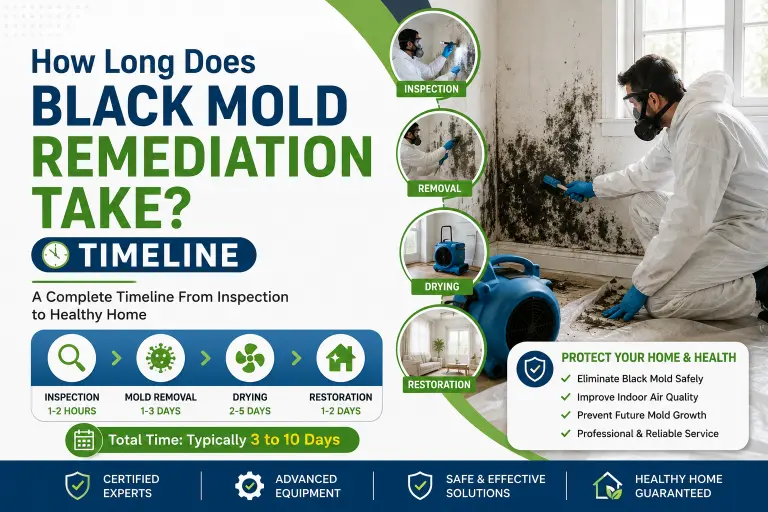
How Long Does Black Mold Remediation Take? Timeline
If you are dealing with black mold, one of the first questions is usually simple: how long will the remediation take?
For a small, contained problem, professional mold remediation may be completed in a day or a few days. A larger job involving multiple rooms, hidden mold, damaged drywall, insulation, HVAC components, or ongoing moisture can take several days or longer. There is no reliable single number because the timeline depends on what is affected, how far the moisture problem has spread, what materials need to be removed, and whether repairs or drying are required.
For most homeowners, the important distinction is between remediation time and the total time before the room is completely restored. Mold removal may finish before drywall replacement, painting, flooring, or other reconstruction is complete.
The goal is not simply to make visible mold disappear quickly. Proper remediation addresses the moisture source, contains the affected area when needed, removes or cleans damaged materials, dries the space, and checks that the mold and moisture problem has been addressed. EPA guidance identifies moisture control, assessment, containment where appropriate, cleanup, drying, and checking for recurrence as core parts of the process.
How Long Does Black Mold Remediation Usually Take?
A reasonable planning range for a residential mold remediation project is about 1–7 days for many contained jobs, while larger or more complicated projects can take longer.
That range is more useful than promising an exact number of hours because two homes with apparently similar mold growth can require very different work.
Small, contained mold problems
A limited area involving one room or a relatively small amount of affected material may be completed within a day or a few days if:
- The moisture source has already been fixed
- The affected area is easy to access
- Mold has not spread into hidden cavities
- Damaged materials do not require extensive removal
- Containment is straightforward
- Drying can be completed without major delays
A small visible patch does not automatically mean the job is simple, however. Mold behind drywall, under flooring, inside an enclosed cavity, or around an HVAC component can change the scope once the affected area is investigated.
Multi-room or moderate remediation
When mold affects several areas of a home, the work can extend across several days.
The crew may need to establish containment, remove damaged porous materials, clean affected surfaces, use air filtration or drying equipment, and inspect adjacent areas for additional moisture or mold.
The more rooms involved, the more time is normally needed to keep the work organized and prevent contamination from being carried into unaffected areas.
Extensive or hidden mold problems
Larger jobs can take a week or longer, particularly when mold is hidden inside walls, associated with significant water damage, or found across multiple building materials.
EPA guidance recommends additional planning and containment for larger or complex mold problems. Full containment may be appropriate for larger contaminated areas or situations where remediation activities could spread mold to other parts of a building.
This is why a company that promises that every black mold job will be finished in one day is giving you a sales answer rather than a scope-based timeline.
What Determines How Long Mold Remediation Takes?
The visible mold is only one part of the timeline. The condition underneath and around it often matters more.
Size of the affected area
A small area in one bathroom is different from mold affecting a bedroom, hallway, closet, attic, or several connected rooms.
Larger affected areas may require more extensive containment, more equipment, additional labor, and a more careful cleanup process.
EPA’s remediation guidance starts with assessing the size of the mold problem and identifying the types of materials affected before selecting the remediation approach.
Location of the mold
Accessibility can make a major difference.
Mold on an exposed hard surface may be easier to address than mold located:
- Behind drywall
- Inside wall cavities
- Under flooring
- Above ceilings
- Inside insulation
- Around HVAC components
- In attic areas
- Behind cabinets or other fixed materials
If the source cannot be reached without opening a building material, additional work may be necessary.
Moisture source
A mold problem cannot be properly resolved by cleaning the visible growth while leaving the moisture problem in place.
Leaks, condensation, roof intrusion, plumbing failures, excessive humidity, and HVAC-related moisture can all contribute to mold growth.
EPA states that moisture control is the key to mold control, while CDC guidance also emphasizes fixing the moisture problem along with cleaning the mold.
If the source of moisture is still active, remediation may need to pause until the underlying problem is corrected.
Type of material affected
Some materials can be cleaned effectively. Others may be difficult or impossible to clean completely once mold has penetrated them.
EPA notes that porous materials such as ceiling tiles and carpet may need to be discarded when they become moldy because mold can grow into spaces that are difficult to clean completely.
That can add removal, disposal, drying, and later reconstruction to the project.
Hidden mold
Visible mold may not represent the entire problem.
A musty odor without obvious growth, water-damaged drywall, staining, or recurring mold can indicate that moisture or mold is present somewhere that cannot be seen directly.
EPA guidance specifically includes considering hidden mold when evaluating a mold problem.
Finding hidden growth during remediation can change both the scope and the expected completion date.
What Is the Typical Black Mold Remediation Timeline?
A professional remediation project is usually a sequence of steps rather than one cleaning visit.
1. Inspection and Scope Assessment
The first step is determining what is affected and why.
The assessment may consider:
- Where mold is visible
- Where moisture has been present
- What materials are damaged
- Whether hidden areas need investigation
- Whether HVAC systems or other building components may be involved
- How the affected area can be contained
The purpose is to establish the work that actually needs to be done rather than guessing the timeline from the visible spot alone.
2. Moisture Source Correction
If a leak or other moisture source is still active, it needs to be addressed.
Examples include:
- Plumbing leaks
- Roof leaks
- HVAC condensation
- Drainage problems
- Water intrusion
- Excess indoor humidity
This step can happen before or alongside remediation, depending on the situation.
The key point is that removing mold without correcting moisture creates a poor long-term outcome. CDC states that if mold is growing in a home, the mold should be cleaned and the moisture problem fixed.
3. Containment Setup
Containment is used when the affected area and remediation method make it necessary to control the movement of mold-contaminated dust or particles.
The size and location of the affected area influence the containment approach.
EPA guidance describes limited containment for smaller areas and full containment for larger areas or situations where mold could spread during remediation. Negative air pressure can also be used to help keep contaminated air from moving into clean areas.
Containment takes time to install and maintain, but rushing this step can create a larger cleanup problem.
4. Removal and Cleaning
The actual remediation work then begins.
Depending on the affected materials, this may involve:
- Removing mold-damaged porous materials
- Cleaning hard surfaces
- Cleaning structural materials where appropriate
- HEPA-filtered equipment or other appropriate controls
- Bagging and removing contaminated materials
- Cleaning the contained work area
The exact methods depend on the building materials and the scope of contamination.
EPA’s guidance emphasizes cleaning and drying moldy materials and discarding materials that cannot be adequately cleaned.
5. Drying and Moisture Control
Drying can become one of the biggest factors affecting the schedule.
Wet materials may require dehumidification, controlled airflow, water extraction, or other drying measures.
CDC recommends drying wet areas and materials as quickly as possible after water damage, ideally within 24 to 48 hours when feasible, because moisture supports mold growth.
For an existing mold problem, the drying period depends on what became wet, how deeply moisture entered the material, indoor humidity, ventilation, and the equipment being used.
6. Final Cleaning and Evaluation
The job is not finished simply because the visible black spots have disappeared.
EPA’s completion guidance says the moisture problem should be corrected and visible mold, mold-damaged materials, and moldy odors should no longer be present. The area should also be checked for signs that moisture or mold is returning.
This final stage helps distinguish actual remediation from a quick surface treatment.
What Can Make Black Mold Remediation Take Longer?
Homeowners often expect a straightforward cleaning job and then discover that the timeline has changed. Usually, one of several factors is responsible.
Mold behind drywall or inside walls
If mold is found behind drywall, the affected material may need to be opened or removed before the full extent of the problem can be addressed.
That creates additional work and may also introduce a separate reconstruction stage.
If drywall needs to be removed or replaced, see our dedicated Drywall Mold Removal Hollywood FL service for the specific issue.
Extensive water damage
Water damage can affect more than the surface where mold becomes visible.
Flooring, insulation, drywall, framing, cabinets, and other materials may need to be evaluated.
If materials remain damp, the project cannot be treated as a simple surface-cleaning job.
Hidden mold
A project can take longer when investigation reveals additional affected areas.
For example, a small visible patch around a wall opening may turn out to be connected to moisture inside the wall cavity.
That is one reason a realistic remediation timeline is usually provided after assessment rather than before anyone examines the affected area.
HVAC involvement
Mold associated with HVAC equipment or ductwork introduces another layer of inspection and cleaning.
EPA specifically includes HVAC systems among the special concerns that may require attention during mold remediation.
If your concern is specifically mold inside an AC or HVAC system, see HVAC Mold Removal Hollywood rather than treating an HVAC problem as an ordinary wall-cleaning job.
Drying takes longer than expected
High humidity, saturated materials, poor airflow, hidden moisture, or an unresolved leak can extend the drying phase.
This is especially relevant in South Florida, where air conditioning, condensation, plumbing leaks, storms, and high humidity can all contribute to moisture problems.
The solution is not simply to run a stronger cleaning chemical. The moisture condition has to be addressed.
How Is Black Mold Remediated?
Black mold remediation is not simply spraying a chemical on dark-colored growth.
The exact procedure depends on the affected material and the size and location of the problem, but the basic approach is to identify the moisture source, control the affected area, remove or clean contaminated materials appropriately, dry the space, and verify that the problem has been addressed.
Why Surface Treatment Alone May Not Be Enough
Painting over mold, caulking over it, or applying a product without correcting the moisture source does not solve the underlying problem.
CDC specifically advises against covering mold with paint or caulk and says the water problem should be fixed and mold cleaned before those finishes are applied.
This matters when a homeowner sees a contractor make a dark stain disappear but the moisture source remains.
Does Remediation Mean Every Spore Is Removed?
No.
Mold spores are present in both indoor and outdoor environments. The objective of remediation is to remove mold growth and address the conditions supporting it, not to create an environment containing zero mold spores.
CDC notes that no indoor space is completely free from mold spores and that remediation should focus on addressing the mold and moisture problem.
That distinction is useful when comparing a legitimate remediation plan with claims that a company can make a home completely “mold-free.”
How Successful Is Black Mold Remediation?
Successful remediation is not measured by how quickly a dark patch disappears.
A better question is: Was the mold removed, was the moisture problem corrected, and is the area free from visible mold, mold-damaged materials, and persistent mold-related conditions?
EPA’s guidance identifies several completion indicators, including correcting the moisture problem, completing mold removal, having no visible mold or mold-damaged materials remaining, and checking the area afterward for returning moisture or mold.
Why Mold Can Come Back After Remediation
Recurring mold usually deserves another look at the building conditions.
Possible contributors include:
- An unresolved leak
- Persistent condensation
- High indoor humidity
- Moisture behind a wall
- HVAC-related moisture
- Wet materials that were not fully dried
- A new water intrusion event
A Reddit discussion about a failed remediation illustrates why drying matters: one homeowner reported mold returning after a dehumidifier stopped working while the basement remained at very high humidity.
That individual experience is not a scientific measure of remediation success, but it reflects a practical issue homeowners often overlook: the moisture problem can be just as important as the visible mold.
Why Some Mold Remediation Jobs Take Longer Than the Estimate
People discussing mold remediation online often focus on the same frustration: they receive a timeline, then the project becomes longer because additional damage or drying work is discovered.
One recent homeowner discussion involved a water leak, several days of drying, additional mold discovery, and delays while the remediation process was arranged.
Another homeowner described a large apartment project where the remediation company expected three days of mold work, but the owner still had to account for separate reconstruction afterward.
These examples highlight an important distinction:
Mold remediation time is not always the same as total repair time.
If drywall, flooring, cabinets, insulation, or other materials must be rebuilt after remediation, construction can continue after the mold-related work has ended.
Can You Speed Up Black Mold Remediation?
You can reduce unnecessary delays, but trying to make remediation “as fast as possible” should not mean skipping containment, drying, material removal, or moisture correction.
Fix the Water Problem First
An active leak can undermine the entire project.
Have the source identified and repaired so newly cleaned or replaced materials are not exposed to continuing moisture.
Make the Affected Area Accessible
Furniture, stored belongings, cabinets, or other obstacles can slow down access to the affected area.
Ask the remediation company what needs to be moved before work begins.
Do Not Start Unplanned Demolition
Opening walls or pulling out materials without knowing the extent of the problem can disturb mold and complicate the work.
If hidden mold is suspected, the remediation plan should account for the possibility before materials are disturbed.
Avoid Rushing the Drying Stage
Drying is not a step that should be skipped to meet a deadline.
EPA and CDC guidance both emphasize moisture control and rapid drying after water damage.
A shorter invoice timeline is not useful if the same moisture condition causes the mold problem to return.
Do You Have to Leave Your House During Mold Remediation?
Not always.
Whether you can remain in the home depends on the size and location of the affected area, containment, the remediation methods being used, the condition of the building, and who occupies the space.
For larger or more disruptive projects, temporary relocation may be appropriate.
If a remediation company tells you that you must leave, ask which area is being remediated, what containment will be used, how long the work is expected to last, and what conditions must be met before re-entry.
CDC disaster cleanup guidance advises that mold cleanup should be complete before reoccupying an affected home.
Can Black Mold Be Fully Remediated?
Yes, a mold problem can be successfully remediated, but “fully remediated” does not mean eliminating every mold spore from the building.
The practical goal is to remove mold growth and damaged materials that require removal, correct the moisture source, clean affected areas, dry the building, and prevent the conditions that allowed the mold to grow. EPA uses the absence of visible mold, mold-damaged materials, and moldy odors, along with correction of the moisture problem, as important completion indicators.
How Long Should You Wait Before Returning Home?
There is no universal number of hours that applies to every remediation project.
Re-entry depends on the scope of work, containment, cleanup, drying, and whether the affected area has been properly cleared for occupancy.
For a small contained project, the work may be completed relatively quickly. For a larger project, occupants may need to stay out for longer.
The safest approach is to follow the remediation plan and the instructions provided for re-entry rather than using a fixed “24-hour” or “48-hour” rule for every situation.
Frequently Asked Questions
What is the typical timeline for black mold remediation?
Many contained residential jobs take about 1 to 7 days, but larger projects involving hidden mold, multiple rooms, extensive water damage, or reconstruction can take longer.
How long does it take to get rid of black mold?
A small, accessible problem may be addressed within a day or a few days; larger or hidden problems can require several days or longer depending on the materials and moisture conditions.
How is black mold remediated?
Professional remediation generally involves assessing the problem, correcting moisture, using containment when appropriate, removing or cleaning affected materials, drying the area, and checking that the problem has been addressed.
How successful is black mold remediation?
Remediation can be successful when mold growth is removed, affected materials are properly handled, and the moisture source is corrected. Recurring moisture can allow mold to return.
What factors make black mold remediation take longer?
The main factors include the size and location of contamination, hidden mold, damaged drywall or insulation, HVAC involvement, active moisture, containment requirements, and drying time.
Can you stay in a house during mold remediation?
Sometimes, depending on the affected area and containment plan. Larger or more disruptive projects may require occupants to leave until cleanup is complete.
Can mold remediation take more than a week?
Yes. Extensive contamination, hidden mold, multiple rooms, difficult drying conditions, major water damage, or reconstruction can extend the project beyond a week.
Does mold remediation include drywall replacement?
It can include removal of mold-damaged drywall, but reconstruction and finishing work may be a separate stage. The need for replacement depends on the material and extent of damage.
Why does mold come back after remediation?
Recurring mold often points to an unresolved moisture source, condensation, hidden dampness, HVAC moisture, or another condition that continues to support mold growth.
Is a three-day mold remediation realistic?
It can be realistic for some contained projects, but the same timeline cannot be applied to every home. The scope, materials, moisture conditions, and containment requirements determine the actual schedule.
How long does black mold remediation take in Hollywood, FL?
A contained Hollywood home may be completed in a few days, while larger or hidden problems can take longer. The local climate, AC use, water intrusion, and humidity can also affect moisture and drying conditions.
When to Call for Black Mold Remediation in Hollywood, FL
If you have visible dark mold, recurring mold growth, a persistent musty odor, or mold associated with water damage, the next step is to determine why it is there and how far the problem extends.
This is especially relevant when mold is found:
- Behind or around drywall
- Under sinks or cabinets
- In bathrooms
- Around HVAC or AC components
- In attics
- After a roof or plumbing leak
- After significant water intrusion
- In more than one room
For homeowners in Hollywood, FL, the remediation timeline should be based on the actual condition of the property rather than a generic promise that every job will take one day.
For service information, see Black Mold Removal Hollywood FL.
Need to discuss a mold problem in Hollywood, FL? Call 954-676-1007 to ask about an assessment and the expected remediation scope.

One Comment